About a month ago, I purchased and planted Ferry-Morse Bouquet dill seeds after I had planted the last of the Dukat dill seed packet from Seeds of Change. I thought that it'd be interesting to compare the two varieties both as plants, and as a culinary herb.
Here's a slideshow of their sprouting progress so far:
Also, four more habanero seeds have germinated!
That brings the habanero seedling count to six so far, and I still have three slots that have not germinated anything.
I was so impressed and pleased with the germination success of the habanero seeds, that I decided to press my luck and try to germinate seeds from a Thai green chile pepper that dried out in the refrigerator in the same bag as the habaneros. I harvested around 18 seeds from one pepper and planted two per slot in a germinating tray. I was out of germinating soil, so I just used potting soil, which is denser. Hopefully, at least a few of them will germinate and I can have a real spicy pepper assortment.
Showing posts with label dill. Show all posts
Showing posts with label dill. Show all posts


14.2.10
more transplanting and a(nother) new greenhouse
After only two weeks, the tomato and pepper plants are already growing out of their peat pots:


The second batch of Maglia Rosa cherry and Dukat dill had also outgrown their containers:


Close-ups, Dukat dill:

Garden sage and Purple Opal basil:


I need more containers before I can transplant the rest of the Purple Opal basil. Then I can use all of the shelf space in the new greenhouse for transplanted tomatoes.


The second batch of Maglia Rosa cherry and Dukat dill had also outgrown their containers:


So I decided to do some more transplanting. Since the tomatoes had outgrown their new pots so quickly, I chose a much larger upgrade, and bought 50 round, plastic "Classic 200" containers. They are tapered, measuring ~5.75" deep and in diameter. So far I've only transplanted 10 of the tomato plants, and of those, most are Santiam and Red House Free Standing.
In order to be able to transplant the tomatoes, I needed to have a space for the plants in their larger containers. I bought from Lowe's a "Garden Treasures" greenhouse for $40. It's 64" x 35.5" x 19" and has a really nice heavy-duty clear plastic cover with two zippers running up the front to make for convenient access to the plants.

I've installed this new greenhouse in the south-facing sun room on the first floor. This room is heated through vents in the floor, and I've positioned the greenhouse so that it is on top of half of one of the vents. This seems to be providing sufficient heat and airflow to the structure.
It still isn't consistently sunny here, so I've installed a 2' single T5 bulb fixture as supplementary lighting. So far, I've transplanted and moved one each of Crimson Sprinter and Oregon Spring Bush tomato, and four each Santiam and Red House Free Standing tomato. The Santiam and RHFS are both determinates that are supposed to reach maximum heights of ~30", so I'm not too worried about them outgrowing the structure any time soon. I moved the Crimson Sprinter and OSB as more of an experiment to see how they'd do in a cooler and darker environment as compared to the growing shelf of the main greenhouse structure. Even if this noticeably slows down the growth of these tomato plants, it will only help to space out the eventual tomato harvest.
The newly-transplanted Maglia Rosa cherry tomatoes have joined the larger transplanted tomatoes in the new greenhouse.


I think they look dwarfed there by the other tomato plants, and even the basil. Again, it will be interesting to compare their growth in this environment with the other Maglia Rosa plants growing in the warmer and brighter greenhouse.
All of the Garden sage, (second batch) Dukat dill, and Slow Bolt cilantro have now been transplanted into more permanent containers and placed by a window.


Close-ups, Dukat dill:

Garden sage and Purple Opal basil:


Purple Opal basil hanging by a west-facing window in the sun room:

I need more containers before I can transplant the rest of the Purple Opal basil. Then I can use all of the shelf space in the new greenhouse for transplanted tomatoes.
11.2.10
fan installed and incredible growth continues
I finally installed a fan on the growing shelf to help circulate the air.
Small fan attached to the greenhouse structure on the growing shelf blowing air just above the tops of the plants:

I'm thinking that this will be useful in two main ways. One, keeping the air moving should help to prevent all the hot air from rising to and staying at the top of the greenhouse structure. Two, it will prevent stagnant air in the greenhouse. Stagnant air can allow pest problems and mold to develop, and also can starve the plants of CO2. In the Greenhouse Gardener's Companion, Shane Smith writes that in still air a plant can draw out most of the CO2 just above the surface of its leaves, creating an envelope of CO2 deficient air. Adding a fan to stir up the air around the plants prevents this type of CO2 deficiency. It also helps to strengthen the stem and roots of the plant by mimicking wind. This is especially important if the plants are going to be transplanted outside later.
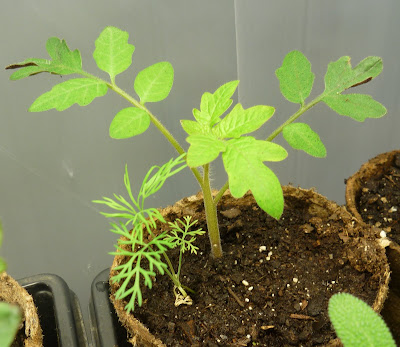
The second batch of Dukat dill on the germinating shelf has really taken off. I have no idea why more of the seeds didn't germinate the first time I planted them, but they are doing fantastically this time. They have all put out their primary leaves, and probably will need to be transplanted soon.
Dukat dill on the germinating shelf:


They have already surpassed in height the lone dill plant from the first batch of seeds.
All the plants on the growing shelf continue to exceed my most optimistic expectations. An excerpt:
Oregon Spring Bush tomato:


Red House Free Standing tomato:


Chadwick cherry tomato:

Fox cherry tomato:

Pimientos de Padrón:

Purple Opal basil:

Small fan attached to the greenhouse structure on the growing shelf blowing air just above the tops of the plants:

I'm thinking that this will be useful in two main ways. One, keeping the air moving should help to prevent all the hot air from rising to and staying at the top of the greenhouse structure. Two, it will prevent stagnant air in the greenhouse. Stagnant air can allow pest problems and mold to develop, and also can starve the plants of CO2. In the Greenhouse Gardener's Companion, Shane Smith writes that in still air a plant can draw out most of the CO2 just above the surface of its leaves, creating an envelope of CO2 deficient air. Adding a fan to stir up the air around the plants prevents this type of CO2 deficiency. It also helps to strengthen the stem and roots of the plant by mimicking wind. This is especially important if the plants are going to be transplanted outside later.
The second batch of Dukat dill on the germinating shelf has really taken off. I have no idea why more of the seeds didn't germinate the first time I planted them, but they are doing fantastically this time. They have all put out their primary leaves, and probably will need to be transplanted soon.
Dukat dill on the germinating shelf:


They have already surpassed in height the lone dill plant from the first batch of seeds.

All the plants on the growing shelf continue to exceed my most optimistic expectations. An excerpt:
Oregon Spring Bush tomato:

Crimson Sprinter tomato:

Red House Free Standing tomato:

Santiam tomato:

Maglia Rosa cherry tomato:

Chadwick cherry tomato:

Fox cherry tomato:

Pimientos de Padrón:

Purple Opal basil:

6.2.10
first transplant slideshow
Here's a slideshow of all the plants after their first transplant.
I really can't believe how quickly the tomato plants are recovering. The Maglia Rosa cherry tomato plants all had roots growing ~5" past their plastic slots, so I guess I waited too long. Thankfully, all the tomato plants seem to be doing fantastically now.
Today, I had to raise the 2' 2-bulb fixture on the germinating shelf since the second batch of Maglia Rosa cherry tomato and Dukat dill have both gotten so tall.
Germinating shelf, Dukat dill and Maglia Rosa cherry tomato:

Dukat dill, second batch:

Maglia Rosa cherry tomatoes, second batch:

I can't believe how many tomato plants (and hopefully, therefore, tomatoes) I'm going to have.
I installed another velcro flap this morning. So there are now two providing access to the front of the germinating shelf, and one each on the front and back of the growing shelf. It's nice to be able to get in and out of the greenhouse so easily, but the greenhouse temperature seems to be decreasing as the number of flaps increases, which suggests that there's air is leaking out through the velcro seals. As it gets warmer out, this won't be as much of an issue. For now, I'm covering the velcro with packing tape to make a tighter seal.
8.1.10
Dukat Dill sprouted, insulation issues
I seem to be having the same situation with the Dukat Dill as with the tarragon: very sporadic germination. There´s at least one solid sprout, and a couple of others that have broken the surface, but don´t seem to be doing much.
Dukat Dill, day 16:

Overall, it's not a very impressive germination yield at day 16 considering they were supposed to germinate in 10-14 days. It's possible that the tray is too warm for them. The seed packet says a soil temperature of 60-75F is required, and it's possible that since tray 2 is closer to the heater and has the seedling heat mat that it's significantly warmer than 75F. Maybe I should try re-sowing them in the tray 1 slots where the tarragon didn't germinate.
The flannel sheet greenhouse insulation seems to be working well now. I quickly found out that there were consequences to increased insulation, mainly, the heater didn't turn on as frequently. Ultimately, this was what I wanted, but not at the expense of the plants on the top shelf (farthest from the heater). Two mornings in a row, the temperature of the top shelf was below 70F.
My current solution to this problem is to wrap the heater shelf less than the other two. I also re-taped the edges of the greenhouse structure where the plastic sheets overlap so as to prevent heat and moisture from escaping. It seems to be working; the temperature of the top shelf was above 70F this morning, which is where I'd like to keep it.
Subscribe to:
Posts (Atom)


 Posts

